
Thinking About Plastic Surgery Abroad? Read This Before You Choose a Clinic

Medical Author

Founder and CEO of BeautyMedTravel
Cosmetic surgery abroad has never been more accessible. A few searches on Instagram, TikTok, YouTube, or Google can produce hundreds of clinics promising dramatic transformations, luxury recovery packages, and prices that seem far lower than those at home. For many patients, the options can feel overwhelming.
The challenge is not finding a clinic. The challenge is knowing which clinics are genuinely safe. In a market crowded with polished social media content, influencer endorsements, and aggressive marketing, it can be difficult to distinguish experienced surgeons and accredited facilities from businesses that simply present themselves well online.
Credentials, safety standards, consultation quality, and aftercare are often far less visible than before-and-after photos and promotional offers. This is why research matters.
While many patients have successful experiences with cosmetic surgery abroad, others discover too late that social media popularity is not the same as medical credibility.
A clinic’s Instagram feed, TikTok videos, or online testimonials can provide useful information, but they should never be the foundation of a decision involving your health and safety.
We’re not here to discourage you from having surgery abroad. We’re here to help you evaluate clinics more critically, verify what you’re being told, and make informed decisions based on evidence rather than marketing.
The patients who achieve the best outcomes are rarely the ones who choose the cheapest package or the most viral clinic. They are the ones who prioritize safety, ask the right questions, and take the time to research thoroughly before booking.
Quick Answer: What Makes a Cosmetic Surgery Clinic Trustworthy?
Before diving into detail, here is a quick overview. A trustworthy cosmetic surgery clinic abroad usually has:
- Verified surgeon credentials: Board-certified (or equivalent) in plastic surgery with extensive experience in your specific procedure.
- Accredited facilities: Independent certifications like JCI (Joint Commission International) or national equivalents, ensuring safety standards.
- Transparent, direct consultations: You speak with the actual surgeon, not just a coordinator, with a full medical history review.
- Realistic expectations and risks: No “guaranteed” perfect results; clear discussion of complications and revisions.
- Structured aftercare: Proper recovery planning, follow-up, and access to medical records.
- Honest communication: No high-pressure sales or social-media-only presence.
If a clinic cannot provide all of the above, that is worth pausing over (regardless of how attractive the package looks).
Organizations like the International Society of Aesthetic Plastic Surgery emphasize the importance of choosing properly trained and board-certified plastic surgeons with ethical standards and verified qualifications.

Why Choosing the Right Clinic Matters More Than Choosing the Right Country
One of the biggest misconceptions in medical tourism is the idea that an entire country is either “safe” or “unsafe” for cosmetic surgery.
In reality, good and bad clinics exist everywhere.
There are excellent surgeons in Turkey, South Korea, Thailand, Mexico, the United States, and the United Kingdom. There are also clinics in every country that rely heavily on marketing while offering inconsistent medical standards.
Patients often ask, “Is cosmetic surgery in Turkey safe?”
When they should be asking, “Is this specific clinic and surgeon safe for my procedure?”
That distinction matters.
Research increasingly supports that idea. A 2025 study published in Plastic & Reconstructive Surgery, Global Open, analyzed more than 2,300 patients who had cosmetic procedures abroad. The findings showed that complication rates were comparable to and in some cases lower than US benchmarks, but only when patients were treated in highly controlled environments with board-certified surgeons and structured pre- and post-operative care.
A highly experienced rhinoplasty surgeon who performs hundreds of revision nose surgeries every year may be a safer choice than a general cosmetic provider in a more expensive country who rarely performs complex nasal work.
Procedure specialization matters enormously in cosmetic surgery.
A surgeon who mainly performs body contouring may not be the best choice for deep-plane facelifts. A clinic known for hair transplants may not have the same expertise in breast reconstruction or rhinoplasty.
The safest approach is to evaluate:
- the individual surgeon
- their training
- their specialization
- their surgical volume
- their consultation quality
- their recovery systems
not simply the destination itself.
The Biggest Red Flags Patients Should Never Ignore
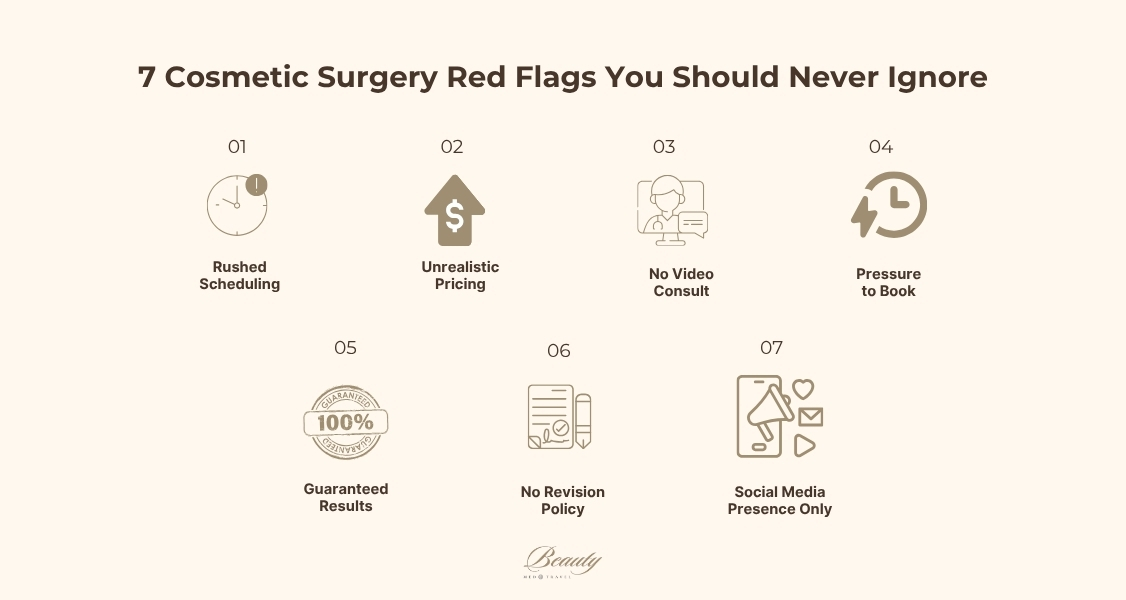
Many patients who have bad experiences abroad later realize there were warning signs they ignored. These are some of the most important cosmetic surgery red flags to notice and take seriously.
No Direct Consultation With the Surgeon
This is one of the most common and most overlooked warning signs. Many clinics abroad use patient coordinators to handle communication with international patients. They may be friendly, responsive, and speak your language fluently, but they are not medical professionals.
A conversation with a coordinator is not the same as a consultation with a surgeon.
This matters because cosmetic surgery is a medical procedure, not a travel booking. The surgeon needs to assess your anatomy, medical history, goals, and suitability for surgery before any decision is made.
British plastic surgeon Simon Withers has publicly pointed out that some patients traveling abroad only meet their surgeon a few hours before surgery. That is not enough time for a proper consultation or informed decision-making.
He says, “Look beyond glossy brochures and the hard sell, talk to a surgeon.”
What to look for:
- A direct consultation with the surgeon before committing
- A video consultation whenever possible
- A review of your medical history and expectations
- The opportunity to ask questions directly to the operating surgeon
- A clinic that treats surgeon access as essential, not optional
Surgery Scheduled Within 24 Hours of Arrival
This is another growing concern in medical tourism. Scheduling surgery within 24 hours of arrival leaves very little time for proper medical evaluation, blood work, informed consent, or simply reconsidering the decision after travel fatigue.
This matters because patients need time for pre-operative assessments, final consultations, and informed decision-making. Travel exhaustion, dehydration, and stress can also affect recovery and overall readiness for surgery.
What to look for:
- A dedicated pre-operative assessment before surgery
- Time scheduled for final consultation and questions
- Blood work and medical evaluations completed before the procedure
- At least a short adjustment period after arrival
- A clinic that prioritizes safety over scheduling convenience
Guaranteed Results
No surgeon can promise a perfect or guaranteed result. Every patient heals differently, and factors like anatomy, swelling, scarring, and tissue response can affect the final outcome.
This matters because realistic expectations are a core part of ethical cosmetic surgery. Any clinic promising perfection may be prioritizing marketing over medical reality.
What to look for:
- Honest discussion of risks and limitations
- Realistic outcome expectations
- Clear explanations of possible complications
- Before-and-after photos presented as examples, not guarantees
- Surgeons who explain both what surgery can and cannot achieve
Pressure to Book Quickly
Reputable surgeons do not pressure patients into making rushed decisions. If you are told a discount expires tomorrow, a surgery slot is about to disappear, or you must pay immediately to secure a package, take a step back.
Ethical medical care should never feel like a sales pitch. Cosmetic surgery is a major medical decision, and you should have enough time to think carefully before moving forward.
What to look for:
- Sufficient time to consider your options
- Transparent pricing that does not depend on immediate decisions
- Staff who answer questions without creating urgency
- Written information you can review independently
- A consultation process focused on education rather than closing a sale
Vague Credentials
Many clinic advertisements use phrases like:
- “Internationally certified”
- “World-renowned”
- “Cosmetic expert”
- “Board-certified cosmetic surgeon”
At first glance, these titles may sound reassuring. But in cosmetic surgery, credential language can sometimes be vague or misleading.
This matters because not all certifications represent the same level of surgical training, and some titles may sound more impressive than they actually are. It is important to look beyond marketing terms and verify the details yourself.
What to look for:
- The exact medical board or association name
- The surgeon’s specialty and formal training
- Confirmation that licenses and certifications are active
- Membership in recognized professional organizations
- Experience with your specific procedure
A reputable clinic should be transparent about a surgeon’s qualifications and willing to provide clear information when asked.
Prices That Seem Unrealistically Low
Good cosmetic surgery involves experienced surgeons, qualified anaesthesiologists, accredited surgical facilities, sterile equipment, and proper aftercare. All of that comes at a cost. So when a clinic offers prices far below the usual range, even considering lower costs in that country, it is reasonable to ask what may have been compromised to make the price so low.
This does not mean the most expensive clinic is automatically the best. But if a rhinoplasty package costs a little more than a short holiday, it is worth looking more closely at what is actually included.
What to look for:
- A detailed breakdown of what is included in the price
- Information about the surgeon, facility, and aftercare
- Transparent explanations for pricing differences
- Costs related to medications, follow-up care, and revisions
- Pricing that appears consistent with the complexity of the procedure
No Clear Aftercare or Revision Policy
Ask yourself: what happens if something does not go as planned?
A trustworthy clinic should clearly explain its aftercare process, follow-up support, and revision policies before you book. If the answers are vague or unclear, you may end up handling complications or unexpected costs alone once you return home.
This matters because surgery does not end when you leave the operating room. Recovery, follow-up care, and complication management are all part of the treatment process.
What to look for:
- A written aftercare plan
- Scheduled follow-up appointments
- Clear revision policies
- A named point of contact after surgery
- Specific guidance on handling complications after returning home
A Social-Media-Only Presence
A strong Instagram account does not automatically mean a clinic is reputable. If a clinic has no clear physical address, no named surgeons, no independent reviews, and no visible accreditation, you should be very careful.
This matters because social media is a marketing platform. While it can be useful for research, it should never be the primary evidence that a clinic is safe and credible.
What to look for:
- A verifiable clinic address
- Named surgeons with independently checkable credentials
- Independent reviews across multiple platforms
- Facility accreditation information
- A professional website with detailed medical information
Social media can be part of a clinic’s marketing, but it should never be the only evidence of credibility.
How to Verify a Cosmetic Surgeon Abroad
Many patients are told to “check credentials,” but this advice is often vague in practice. The result is that marketing terms get mistaken for medical qualifications.
This matters because cosmetic surgery outcomes depend less on branding and more on verified surgical training, procedural experience, and accountability systems.
Here is how you can verify a safe plastic surgeon abroad:
1. Formal Qualification
What to look for:
- National plastic surgery board certification (not general medical registration)
- A recognized specialty in plastic and reconstructive surgery (not general or unrelated medical fields)
Do not rely on self-described titles like “cosmetic expert” or “aesthetic specialist,” as these are not regulated medical designations in many countries.
2. International Recognition
What to look for:
- ISAPS (International Society of Aesthetic Plastic Surgery) verified membership
- EBOPRAS certification (where applicable in Europe)
- Equivalent national plastic surgery societies in the surgeon’s country of practice
These affiliations matter because they are independently verified and cannot simply be self-declared.
Many Reddit discussions from cosmetic surgery communities repeatedly warn patients not to confuse “cosmetic certification” with formal plastic surgery board certification.
What you are looking for is a surgeon whose credentials can be independently verified, not simply claimed on a website.
3. Procedure-Specific Experience
What to look for:
- Number of times the surgeon has performed your specific procedure
- Experience with revision cases (not just primary surgeries)
- Clear alignment between the surgeon’s main specialization and your procedure
A qualified surgeon is not automatically the right surgeon for every procedure.
Additional Safety Checks
- Confirm hospital privileges and where the surgery will actually take place
- Verify facility accreditation (e.g., JCI or equivalent national standards)
- Ask directly about complication handling and revision policies
A surgeon who cannot clearly explain these points is a risk, regardless of marketing presence or clinic reputation.

How to Evaluate Before-and-After Photos
Before-and-after photos are one of the most influential tools in clinic selection, but also one of the easiest to manipulate. They should be treated as data, not marketing.
How to Actually Evaluate Before-and-After Photos
Use this checklist when reviewing any clinic’s results:
- Check lighting consistency (same brightness, tone, and shadows in both images)
- Check head angle consistency (similar posture, tilt, and facial orientation)
- Look for realistic healing timelines (results shown at least 3–6 months post-surgery, not early swelling stages)
- Reverse image search 2–3 sample cases to check if images appear elsewhere online
- Compare multiple patients, not just highlights (look for consistency across different cases, not a few selected outcomes)
- Look for imperfect outcomes (real surgeons have variation in healing; not every result is identical)
If a clinic only shows perfect results, you are not seeing the full dataset.
What Authentic Results Look Like
Consistent, credible results usually show patients with similar anatomy to your own, photographed under controlled and consistent conditions.
Long-term results (1–2 years post-surgery) are more reliable than early post-operative images, which can be misleading due to swelling and healing progression.
What Should Raise Questions
- Lighting, angle, or camera distance changes between before and after images
- Results that look overly uniform across very different patients
- “Before” images that appear intentionally unflattering compared to polished “after” shots
- A portfolio that shows only flawless outcomes with no variation
AI-Generated and Stolen Photos
Some clinics have been documented using AI-generated, edited, or stolen imagery in their marketing.
If you are using before-and-after photos as a significant part of your decision-making, invest a small amount of time in reverse-image searching them on Google Images.
Why Social Media Alone Is Not a Reliable Research Tool
Instagram is not a credential. It is a marketing platform, and in the medical tourism industry, clinics often use it very effectively to attract international patients.
The Reality Behind the Curated Feed
The accounts that dominate social media in cosmetic surgery are often driven by carefully selected content, engaged influencer partnerships, and paid promotional arrangements. The photos you see represent the cases a clinic has chosen to share publicly, not a representative sample of all outcomes.
Social media is reportedly filled with both AI-generated and bait-and-switch imaging (in some cases), the outcomes shown are computer-generated or feature entirely different people from those shown in the before photos.
Many patients now discuss concerns online about:
- fake patient accounts
- manipulated testimonials
- reposted photos
- overly curated experiences
Some Reddit discussions specifically describe clinics allegedly presenting promotional content as genuine patient experiences.
Influencer Content Is Not Patient Testimony
When an influencer documents their surgery abroad and shares positive results, that content may be authentic. It may also be a paid arrangement, a discounted procedure offered in exchange for coverage, or a relationship built on commercial interest rather than patient welfare.
This does not mean every influencer review is inauthentic. It means you should not treat it as independent evidence. Look for reviews from patients with no obvious promotional relationship to the clinic, and seek them on independent platforms, not on the clinic’s own social media pages or website.
Fake Reviews: How They Work
One influencer who documented her surgical experience reported that her original clinic’s staff had offered free products to patients in exchange for fake cosmetic surgery reviews. This practice is more common than patients realize. Reviews on Google, Trustpilot, and clinic websites can be influenced, incentivized, or fabricated.
Look for reviews that include specific, credible detail (named staff, procedural specifics, post-operative experiences) rather than generic praise. And look for patterns in negative reviews. If multiple reviewers mention the same concerns (rushed consultations, pressure to book, communication breakdowns post-surgery), it may indicate a consistent problem at the clinic.
What a Proper Consultation Should Include
A cosmetic surgery consultation should be a medical assessment, not a sales conversation. The difference becomes clear when you compare how each one is structured.
| Proper Medical Consultation | Sales-Style Consultation |
|
|
A proper consultation helps you decide whether surgery is appropriate. A sales consultation pushes you toward deciding whether to proceed.
Questions to Ask Before Booking
Use this list as your starting framework. Any credible clinic should answer these questions clearly and without hesitation.
About the surgeon:
- What are the surgeon’s specific qualifications for this procedure?
- Is the surgeon a member of their national plastic surgery society or ISAPS?
- How many times has this surgeon performed this specific procedure?
- Will I be able to speak directly with the surgeon before committing?
About the facility:
- Where will the surgery take place, in what specific facility?
- Is that facility accredited, and by which body?
- Who provides anesthesia, and what are their qualifications?
- What emergency protocols are in place?
About aftercare and complications:
- What follow-up appointments are included, and when do they occur?
- What happens if I experience complications after returning home?
- What is your revision policy, and under what circumstances does it apply?
- Who is my point of contact if I have concerns post-surgery?
About the package:
- What is specifically included in the quoted price?
- What costs are not included (medications, compression garments, follow-up appointments, transfers)?
- Is there a written treatment plan I can review before signing anything?
Understanding “All-Inclusive” Surgery Packages
All-inclusive packages are among the most attractive offerings in medical tourism, and also among the most misunderstood.
The term “all-inclusive” does not have a standard medical definition. What is included varies significantly between clinics.
What “All-Inclusive” Usually Means in Reality
Usually included:
- The surgical procedure
- Accommodation
- Airport and local transfers
Often not included:
- Pre-operative blood work and testing
- Post-operative medications
- Compression garments
- Additional follow-up appointments
- Revision surgery
- Treatment for complications
- Extended hotel stays if recovery takes longer than expected
The key question is not whether a package is all-inclusive. It is whether you know exactly what is included and what is not.
Always request a written breakdown before booking. This should clearly outline every included service, all potential additional costs, and the clinic’s policy on complications, revisions, and extended recovery requirements.
A clinic that focuses heavily on hotels, transfers, and concierge services while providing limited information about the surgeon, facility, aftercare, and complication management may not be placing your surgical outcome at the center of its offer.
Read the terms carefully. Ask what happens financially and medically if complications arise. Get specific answers, not reassurances.
How to Plan Your Recovery Safely
Recovery planning is consistently under-discussed in the research process, and yet it is one of the most significant factors in both safety and outcomes.
Recovery planning is often overlooked, but it is a critical part of surgical safety.
Do Not Fly Too Soon
There is no fixed timeline for flying home after cosmetic surgery. The appropriate length of stay depends on the procedure, your recovery, and your surgeon’s assessment.
Flying too early can increase the risk of deep vein thrombosis (DVT), wound complications, swelling, and infection.
Ask your surgeon one clear question: When is it medically safe for me to fly home? Get the answer in writing, not verbally.
Arrange Follow-Up Care Before You Leave
Before traveling, identify a GP, nurse, or specialist who can support your recovery at home.
Your clinic should provide a complete surgical summary, including the procedure performed, medications, post-operative instructions, and signs of potential complications.
Do not leave without this documentation.
Confirm Insurance Coverage
Do not assume your travel insurance covers cosmetic surgery complications.
Verify that your policy explicitly covers complication-related treatment, hospitalization, and emergency medical care.
Plan for the Unexpected
Know where the nearest hospital is located and who to contact if complications develop.
These questions should be answered before surgery, not after.
Consider Recovery Houses Carefully
Some destinations offer dedicated recovery accommodations with nursing support and post-operative monitoring.
If your clinic recommends one, research it independently and verify the qualifications of the staff providing care.

What Ethical Clinics Usually Do Differently
It is just as important to recognize the signs of a good clinic as it is to spot red flags. Good clinics put patient safety and care first in everything they do.
Ethical Clinics Consistently Do These 6 Things:
- Refuse Unsuitable Patients
A surgeon willing to decline a procedure because it is not appropriate for your anatomy, health status, or expectations is demonstrating clinical integrity. Ethical clinics understand that not every patient is a good candidate, and they are prepared to say no when necessary.
- Document Risk Clearly
Good clinics explain the potential risks, limitations, recovery requirements, and possible complications of a procedure before you commit. These discussions are documented as part of the informed consent process, not hidden in fine print or rushed through on the day of surgery.
- Encourage Delayed Decision-Making
Ethical clinics do not create urgency. They provide information, answer questions, and encourage patients to take time to consider their options. A major surgical decision should never feel like a limited-time offer.
- Provide Surgeon-Led Consultations
Patient coordinators can be helpful for logistics, but clinical decisions should come from the surgeon. Ethical clinics ensure patients have direct access to the doctor performing the procedure before any commitment is made.
- Discuss Complications Openly
No surgery is risk-free. Responsible surgeons discuss complications, revisions, and recovery challenges openly and realistically. They explain not only what happens when everything goes well, but also how unexpected issues are managed.
- Provide Structured Follow-Up Care
Patient care should not end when the operation is over. Ethical clinics have a clear aftercare process, scheduled follow-up appointments, recovery guidance, and a plan for managing concerns after patients return home.
Ultimately, ethical clinics have nothing to hide. They welcome questions, provide transparent information, share verifiable credentials, and support patients in making informed decisions rather than rushed ones.
Final Checklist Before Booking Safe Cosmetic Surgery Abroad
Use this medical tourism safety checklist before making any commitment.
Surgeon verification
- Named surgeon identified, not just a clinic brand
- Credentials verified through ISAPS, EBOPRAS, or national surgical board
- Surgeon specializes in this specific procedure
- Direct video consultation completed with the surgeon
- The surgeon has answered your questions without evasion
Clinic and facility
- Physical clinic address confirmed and independently verifiable
- Facility accreditation checked (JCI or national equivalent)
- Operating facility specifically named and confirmed
- Emergency protocols discussed
Consultation quality
- Full medical history reviewed
- Risks of the procedure explained in relation to your health and anatomy
- Realistic outcome expectations set
- Written treatment plan provided
Package and pricing
- Full list of what is and is not included in the quoted price
- Revision and complication policy confirmed in writing
- Total cost, including medications, follow-up, compression, potential complications understood
Recovery planning
- Minimum stay duration confirmed with the surgeon
- Post-surgery flight clearance confirmed in writing
- Follow-up support arranged at home
- Travel insurance reviewed and confirmed to cover surgical complications
- Surgical summary to be provided for home physician confirmed
Research quality check
- Reviews read across independent platforms, not only the clinic’s own website
- Before-and-after photos evaluated critically
- No pressure to commit has been applied
- No consultation with coordinator used as substitute for surgeon communication
A Final Note
The patients who have the best experiences with surgery abroad are not the ones who found the cheapest package or the most impressive Instagram feed. They are the ones who asked hard questions, verified what they were told, took time to make a considered decision, and chose a surgeon whose qualifications and communication skills genuinely earned their trust.
That process takes effort. It is worth every hour.
At Beauty Med Travel, our approach is medically guided rather than tourism-driven. We work only with surgeons and clinics that meet verified standards. We support patients throughout the research and consultation process to help them make the right decision, not just book faster.
If you are still researching your options, Beauty Med Travel provides medically guided support for clinic evaluation, consultation preparation, and surgeon matching.

Нужна помощь в выборе клиники или доктора?
Заполните форму или позвоните нам для бесплатной консультации
Medical Author

Founder and CEO of BeautyMedTravel